

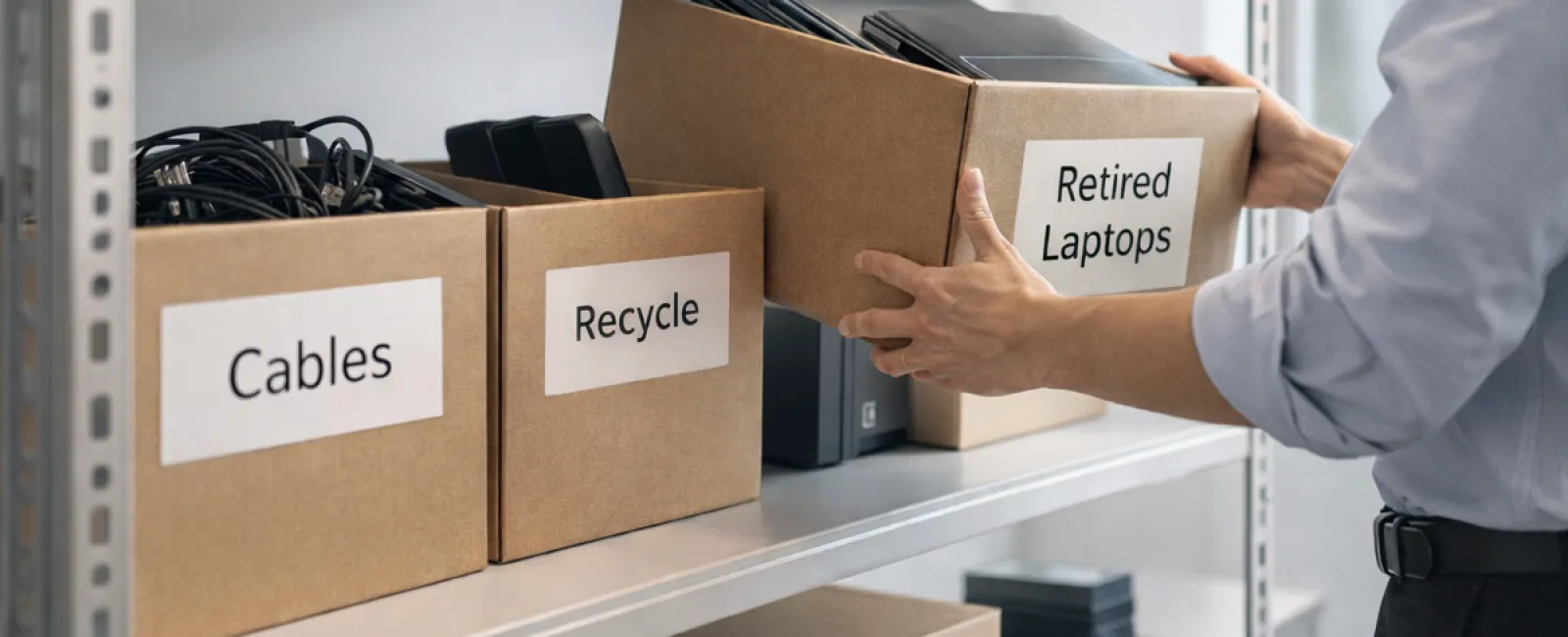
Spring cleaning often begins with closets, but for most companies, true clutter extends far beyond just a rack.
It might be on a server rack, stored away in a back office or storage room, or even piled up with a "we'll handle that later" sign.
Outdated laptops. Decommissioned printers. Backup drives from old upgrades. Boxes of cables no one wants to discard "just in case."
Every organization collects these over time.
The real question isn't if you have this tech clutter, but whether you have a clear strategy for managing it.
Technology Follows a Lifecycle — Beyond Just the Purchase Date
Purchasing new equipment often comes with clear motivation: better speed, enhanced security, improved capabilities, or supporting growth.
While many companies plan their technology purchases meticulously, few invest in planning how to responsibly retire outdated tech.
When retiring equipment, it usually happens quietly—devices get replaced, set aside, and only later is space cleared.
That's typical.
What's less frequent is approaching technology retirement with the same care as its acquisition.
Old devices still hold value, recyclable materials, and potentially sensitive data. Left unmanaged, they can hinder operations by occupying valuable space and attention.
Spring offers a perfect moment to evaluate: Which equipment still adds value and which is merely taking up room?
A Streamlined Process for Organizing Your Technology
To turn this from a vague intention into actionable steps, follow our straightforward four-step framework.
Step 1: Make an Inventory
Identify what's truly being retired: laptops, phones, printers, networking gear, external drives? You can't manage what you don't know exists. A simple walk-through can uncover surprising items.
Step 2: Determine Its Future
Most devices fit into three categories: reuse (within your company or via donation), recycle (using certified e-waste services), or destruction (for sensitive data). The crucial part? Making these decisions deliberately to avoid technology drifting aimlessly into storage.
Step 3: Prepare Devices Correctly
Discipline here pays off.
For reuse or donation, remove devices from your management systems, revoke user access, and perform certified data wiping rather than relying on factory resets. Deleting files or quick formatting only hides data; it doesn't erase it.
Research by Blancco, a data security firm, revealed 42% of resold drives on eBay still contained sensitive info despite sellers claiming proper wiping. Certified erasure tools overwrite all sectors and provide verification reports.
If recycling, always use certified e-waste vendors—not dumpsters or curbside pickups. Note: Best Buy's recycling is for households, not businesses.
For enterprise equipment, seek IT asset disposition (ITAD) providers with e-Stewards or R2 certification. Your IT partner can often handle coordination.
When destroying devices, opt for certified data wiping or physical destruction (like shredding or degaussing), and maintain records of serial numbers, methods, dates, and handlers.
This approach isn't about paranoia—it's about closing the loop confidently.
Step 4: Record and Proceed
Once equipment leaves your premises, you should track where it went, how it was processed, and confirm access removal. Documentation helps eliminate doubt.
Commonly Overlooked Devices
While laptops often get attention, other equipment may be neglected.
Phones and tablets can retain access to emails, contacts, and authentication apps. Factory resets handle most data, but business devices benefit from certified mobile wipe solutions. Major brands like Apple and Samsung offer trade-in programs, sometimes even for older models, which may yield credit for new purchases.
Modern printers and copiers often contain internal hard drives storing everything ever printed, scanned, copied, or faxed. For leased copiers, get written confirmation that hard drives will be wiped or removed before redeployment.
Batteries are classified as hazardous waste by the EPA, and many states (such as California, New York, and Minnesota) prohibit businesses from disposing of rechargeable batteries in regular trash. Remove batteries when possible, tape terminals to prevent shorts, and take them to certified drop-off sites. Call2Recycle.org offers a searchable location map. Retailers like Staples, Home Depot, and Lowe's often accept rechargeable batteries.
External drives and retired servers tend to be stashed away longer than intended but require the same systematic retirement as other devices.
Important Notes About Electronics Recycling
Earth Day in April is a reminder to consider our environmental responsibilities.
Electronic waste shouldn't be dumped in landfills. Over 62 million metric tons of e-waste are generated globally every year, but only about 22% is recycled properly. Items like batteries, monitors, and circuit boards need dedicated recycling streams. Most communities provide certified e-waste programs for this purpose.
Properly managing technology retirement ensures your operations stay organized, environmentally responsible, and secure. You don't have to sacrifice security for sustainability—you can achieve both.
This responsible practice also makes a subtle but positive impression on customers when mentioned in your company's social channels.
The Larger Possibility
Spring cleaning isn't just removing clutter; it's about creating room for growth and innovation.
While clearing old hardware is an important step, it's also a good opportunity to assess whether your current technology supports your business vision.
Hardware cycles in and out, but it's software, systems, automation, and process design that truly drive efficiency and profits.
Properly retiring outdated equipment is smart upkeep, while aligning your tech stack with your strategy will propel your business forward.
How We Support You
If you already have a clear method for retiring equipment, that's perfect—it should feel effortless and routine.
As you plan responsible tech replacement, it's also an ideal moment to review your broader ecosystem: Are your systems optimized? Do your tools integrate seamlessly? Is your technology actively enabling growth or just maintaining the status quo?
We're here to help you take a comprehensive look at how your technology, processes, and tools impact productivity and profitability.
No sales pitch. No equipment checklists. Just a straightforward conversation about optimizing technology for your business success.
Click here or give us a call at (802) 331-1900 to schedule your free Discovery Call.
If this article inspired you, feel free to share it with fellow business owners.
Don't let spring cleaning stop at closets—it's time to refresh the systems that power your business.